
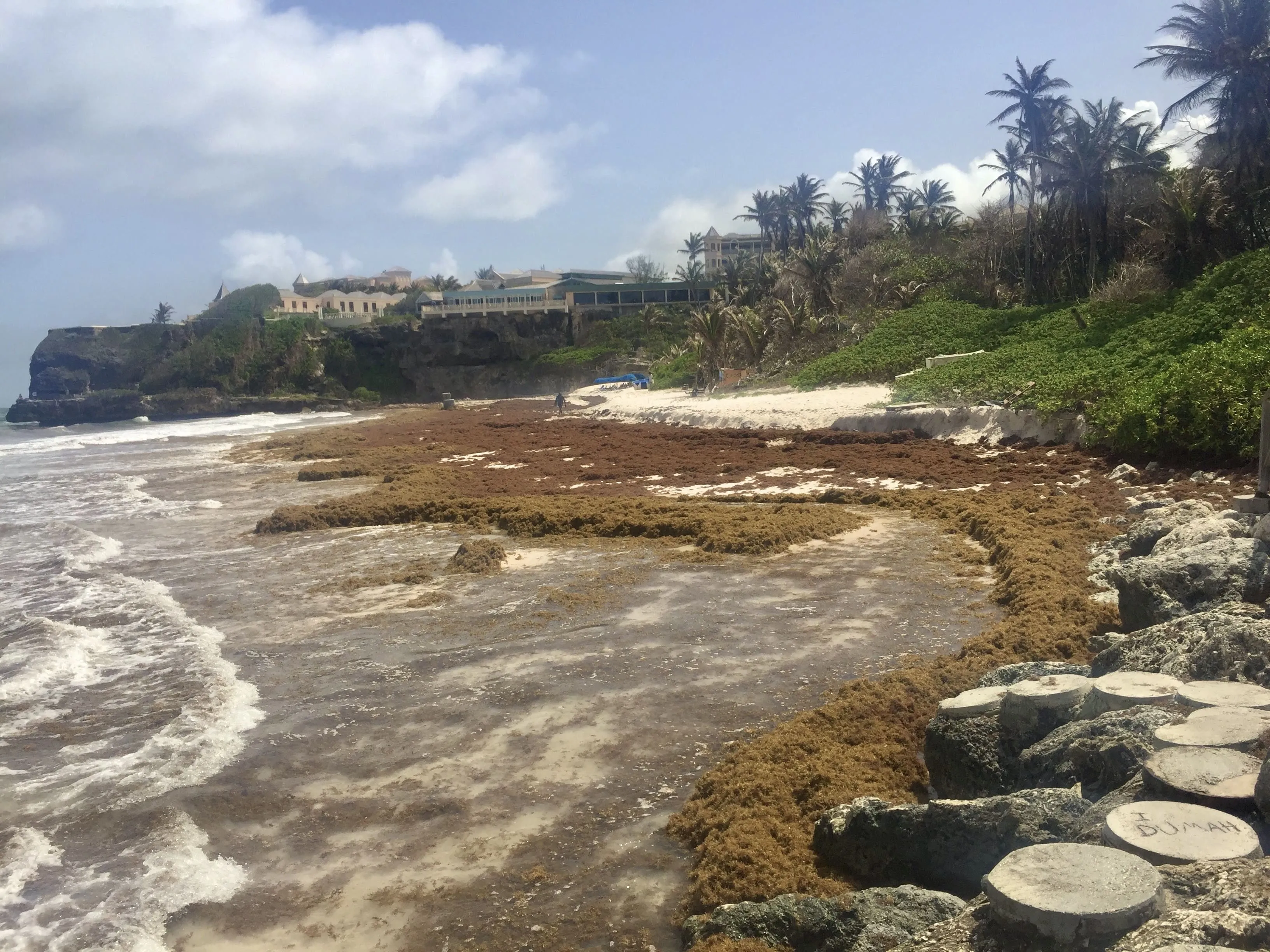
Once again, Caribbean beaches have been invaded by sargassum seaweed, with large clusters of the brown algae drifting off the African coasts of the Atlantic Ocean towards the Caribbean Sea.
Since 2011, this plague has infested the Caribbean's most beautiful beaches on an annual basis, mainly in July and August. While the reason for its proliferation remains unknown, the damage wrought is very real. The seaweed gets tangled up in fishermen's nets or in the engines of their boats, traps little sea turtles that hatch on the beach, forces fish to change their migratory or breeding routes, and drives tourists away from the beaches.
Well then, why not simply capitalize on this free resource, you might ask? For one thing, this raw material is unpredictable, disappearing as suddenly as it appears. Consequently, any investment in the research and equipment needed to manufacture sargassum-derived products would be unprofitable.
In Barbados, even if the magnificent beaches of the west coast have been spared, entrepreneurs have been redoubling their creative efforts to reduce the economic damage caused by this invader. These include transforming seaweed into fertilizer (after drying and desalinating it, which requires large storage areas and quantities of fresh water), and producing soaps and cosmetics, etc. These individual initiatives are to be applauded, but they alone cannot stem the tide.
Recently, research has intensified at the regional academic level, culminating in a clean, sargassum-derived, biofuel produced in the laboratories of the Barbados Cave Hill Campus of the University of the West Indies (UWI). A pilot project will soon be implemented in Barbados, with the opening of service stations offering this algo-fuel. An app will also be used to predict the influx of sargassum into Barbados' exclusive economic zone. A glimmer of hope, perhaps?
Author: Jihane Sfeir
Translation from French: Joy Lewis (